Yutai Guide for English Speakers in Japan: How Shareholder Perks Work
Contents
I am Japanese, and I wrote this guide for English speakers who live in Japan. I have been using yutai for more than ten years. Here are the basics.
What is yutai?
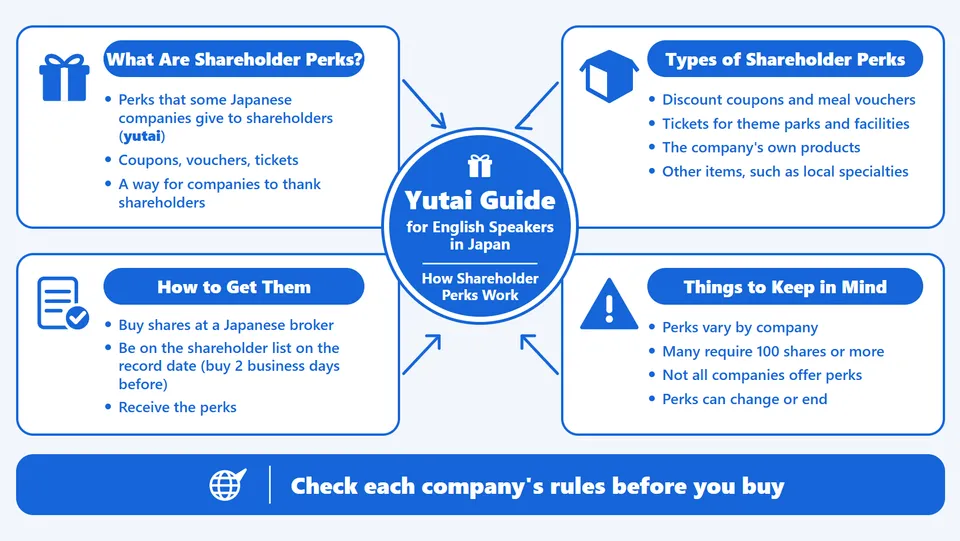
Yutai means "shareholder benefits". Companies offer them to gain fans of their products and stable individual shareholders, according to Daiwa Securities. Common examples are discount coupons, meal vouchers, tickets and the company's own products.
Not every company offers yutai. According to SBI Securities, a company's yutai can start, expand or end depending on its policy. Always check the company's current rules.
How to get yutai
- Open an account at a Japanese broker (see below).
- Choose a company and read its yutai rules on its website: how many shares you need, whether you must hold them for a certain period, and the record date.
- Buy the shares by the last day with rights.
- Be on the shareholder list on the record date.
- Receive the yutai according to the company's schedule. The company's website usually explains how and when it is provided.
The record date and the last day to buy
The record date (権利確定日, kenri kakutei-bi) is the day you must be on the shareholder list. Buying on that day is too late, because it takes time for a purchase to be settled. The last day with rights (権利付き最終日, kenri-tsuki saishū-bi) is two business days before the record date, according to Daiwa Securities and SBI Securities. The next business day is the ex-rights day (権利落ち日), and people who buy then do not qualify.
For example, if the record date is Wednesday, September 30, 2026, the last day to buy is Monday, September 28. Your broker shows the exact date.
How many shares do you need?
Japanese stocks are normally traded in units of 100 shares, according to Japan Exchange Group. This unit is called tan'gen (単元).
- Many companies give yutai only to holders of one unit (100 shares) or more, according to Nomura Securities. Some also require you to hold the shares for a certain period.
- Fewer than 100 shares are called odd-lot shares (単元未満株, tan'gen-miman kabu). Holders have no voting rights but can receive dividends, according to Nomura Securities. Whether they get yutai depends on the company.
- Some brokers sell odd-lot shares. I bought one share of Pasona Group through SBI Securities' S株 odd-lot trading service.
- Some companies reward long-term holders. For example, Pasona Group's 2026 prize draw gives more entries to people who have held the shares for longer.
Can foreign residents get yutai?
Foreign residents of Japan may be eligible for shareholder benefits if they meet the company's requirements and can hold the shares through a suitable brokerage account. Each company sets its own requirements, so check the company's page. The company's yutai requirements and a broker's account requirements are two separate things.
Overseas brokers. I could not find an official statement on whether benefits reach shareholders who buy through a broker outside Japan. If you plan to buy that way, check with the broker and the company's investor relations (IR) department before you rely on the benefit.
Check before you buy
- The conditions. The number of shares, the holding period and the record date.
- The conditions of use. Some yutai have an expiry date, blackout dates or a rule that the shareholder must use it in person. Pasona Group's coupons are an example.
- The risk. Stock prices go up and down, and yutai can change or end. The price of my Pasona share has fallen since I bought it.
A real example: Pasona Group
For 2026, Pasona Group offers Awaji Island discount coupons to all shareholders, including holders of fewer than 100 shares. I used them at Nijigen no Mori with my family. Here is the full story, with the receipts:
Update history
- October 5, 2026: First published
Disclaimer
This article is a personal record and general information. It is not investment advice. Stock prices go up and down, and perks change. Check each company's official page and your broker's page: Daiwa Securities, SBI Securities and Nomura Securities.